America's 250th Should Not Be Controversial
By Dr. Toby A. Travis, Head of School, Intermountain Christian School
Note: This expanded commentary responds to Christine Cooke Fairbanks' Sutherland Institute article, Teaching America's 250th shouldn't be controversial. Good public policy can help. See https://sutherlandinstitute.org/teaching-americas-250th-shouldnt-be-controversial-good-public-policy-can-help.
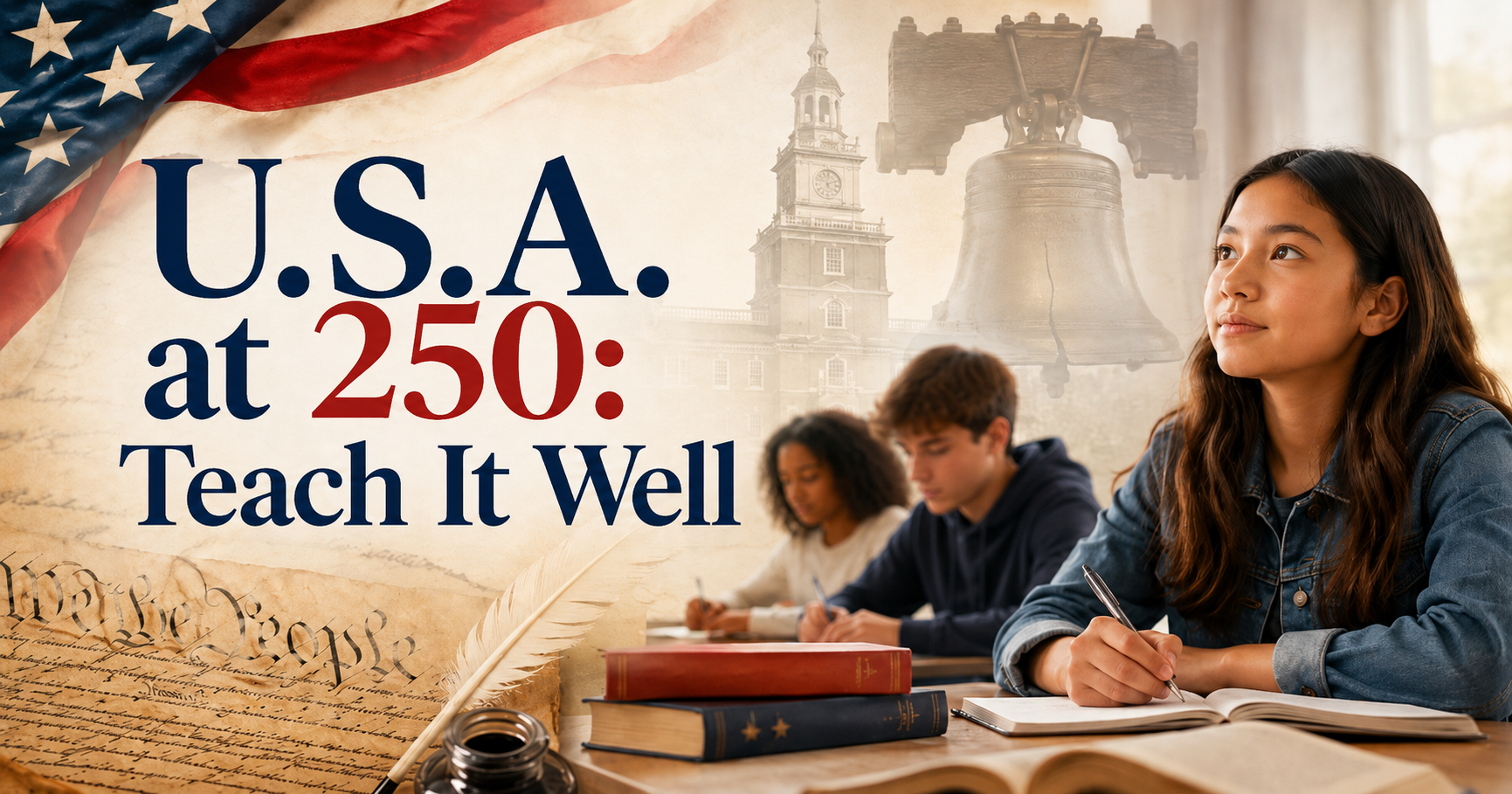
Sutherland Institute is right to argue that teaching the United States' 250th anniversary should not be controversial. In fact, it should be one of the most natural and necessary responsibilities of our schools. The semiquincentennial of the Declaration of Independence is not merely a commemorative date on the calendar. It is a rare instructional moment: an invitation to help students understand the ideas, sacrifices, failures, reforms, and responsibilities that have shaped the American experiment.
That opportunity arrives at a time when schools, parents, and civic institutions cannot afford to be passive. The latest National Assessment of Educational Progress results show a troubling decline in civic and historical understanding. In 2022, only 22 percent of eighth-grade students scored at or above NAEP Proficient in civics, and 31 percent were below NAEP Basic. U.S. history results were even more sobering: only 13 percent of eighth-grade students scored at or above NAEP Proficient, while 40 percent were below NAEP Basic. These are not merely test-score concerns. They are formation concerns.
Students cannot inherit what they have not been taught to understand. They cannot steward what they have never been invited to examine. And they cannot improve what they have been trained only to dismiss or defend without knowledge, humility, and context.
The moment before us
The 250th anniversary of the Declaration of Independence offers schools a remarkable opportunity precisely because civic knowledge is scarce, public trust is fragile, and many young people are uncertain about the meaning and responsibilities of citizenship. We do not serve students well by avoiding the complexity of our national story. Nor do we serve them well by reducing that story to either uncritical celebration or cynical condemnation.
Good education does not ask students to ignore America's failures, contradictions, or unfinished work. It asks them to study those realities honestly, in context, and alongside the founding principles that have made reform, liberty, self-government, and human dignity possible. A mature approach to America's 250th can hold together both gratitude and repentance, celebration and correction, patriotism and truth-telling.
This is why Fairbanks' emphasis on primary sources is so important. Students need to encounter the Declaration of Independence, the Constitution, the Federalist Papers, the Northwest Ordinance, Washington's Farewell Address, Lincoln's Second Inaugural, Frederick Douglass' speeches, the Seneca Falls Declaration of Sentiments, the Gettysburg Address, Dr. Martin Luther King Jr.'s Letter from Birmingham Jail, and the writings and speeches of reformers, presidents, abolitionists, civil rights leaders, veterans, immigrants, and ordinary citizens who helped shape the American story. The point is not to curate a simplistic national myth. The point is to place students in direct conversation with the ideas, arguments, aspirations, and moral tensions that formed the nation.
Research points to a civic-learning gap
The research base strengthens the urgency of this work. NAEP's 2022 results documented the first decline in eighth-grade civics performance since the assessment began in 1998. The National Assessment Governing Board reported that only 22 percent of eighth graders reached NAEP Proficient in civics, while only 13 percent did so in U.S. history. Those numbers suggest that many students are leaving middle school without a strong grasp of the basic knowledge needed to understand constitutional democracy, civic participation, historical change, or the responsibilities of citizenship.
Adult civic knowledge is uneven as well. The Annenberg Constitution Day Civics Survey has shown modest improvement in recent years, but its findings continue to reveal important gaps. In the 2025 survey, 70 percent of U.S. adults could name all three branches of government, up from 65 percent in 2024. Yet fewer than half could name most First Amendment freedoms beyond speech: 48 percent named freedom of religion, and 40 percent named freedom of the press. These findings should encourage schools to do more than teach students to repeat a few familiar phrases. They need students to understand constitutional principles well enough to apply them wisely.
Youth civic engagement research points in the same direction. CIRCLE at Tufts University argues that schools and communities must prepare young people for civic life long before they reach voting age. Its Growing Voters framework calls for sustained civic learning ecosystems, including deep civic content knowledge, classroom discussion of current and controversial issues, media literacy, service learning, and opportunities for student voice. Civic education works best when it is not a single course, event, assembly, or anniversary activity, but a coherent habit of school life.
Recent work from RAND and the Center on Reinventing Public Education also underscores the challenge. Districts are trying to define and support civic learning in an era of polarization, uneven state support, and competing instructional priorities. That reality makes clarity essential. Schools should not retreat from civics because the topic is sensitive. They should teach it with greater transparency, stronger materials, and a clearer philosophy of formation.
A better frame: honesty, context, humility, and trust
The question is not whether schools will shape students' civic imagination. They will. The question is whether that formation will be intentional, truthful, and trustworthy. The most constructive path is neither triumphalism nor cynicism. It is honesty, context, humility, and trust.
Honesty means students should learn the ideals articulated in the Declaration of Independence and the ways those ideals have been honored, violated, contested, and expanded in American history. Context means students should understand historical actors and events in their own time while also asking enduring moral questions. Humility means recognizing that the American story is larger than any one party, ideology, region, textbook, or generation. Trust means schools must be clear with parents and communities about what is being taught, why it is being taught, and how it contributes to the formation of wise, informed, and responsible citizens.
Transparency does not weaken education; it strengthens it. When parents understand the purpose and content of civics instruction, they are far more likely to support it. Schools can build that trust by publishing unit questions, primary-source lists, essential standards, discussion norms, and culminating projects. They can invite parents to see that the goal is not political indoctrination, but disciplined learning, civic literacy, moral reasoning, and constructive engagement.
What should schools do now?
First, schools should anchor the 250th in primary sources. Students should read the founding documents and the words of those who challenged the nation to live up to them. Primary sources reduce the risk of caricature because they require students to engage directly with the text, context, and argument.
Second, schools should teach civic knowledge and civic virtue together. Students need to know how government works, but they also need to practice the dispositions that make self-government possible: truthfulness, courage, patience, respect, gratitude, prudence, and love of neighbor. Knowledge without virtue can become manipulation. Virtue without knowledge can become sentimentality. Civic education requires both.
Third, schools should create structured opportunities for civil discourse. Students need guided practice in listening carefully, asking better questions, supporting claims with evidence, disagreeing charitably, and changing their minds when the evidence warrants it. The C3 Framework's emphasis on inquiry, evidence, deliberation, and civic action is helpful here. The classroom should become a place where students learn that disagreement is not a threat to learning; rightly ordered, it is often one of learning's most powerful tools.
Fourth, schools should include local and personal connections. Students should learn the national story, but they should also discover how their community, state, school, church, family, and local institutions fit within that story. The 250th becomes more meaningful when students can see themselves not as spectators of history, but as participants in an ongoing civic inheritance.
Finally, school leaders should communicate proactively. A trustworthy approach to America's 250th will not surprise parents. It will explain the why, identify the sources, name the learning goals, and invite families into the conversation.
For Christian schools: liberty as moral responsibility
For Christian schools, the opportunity is even deeper. We should help students understand that liberty is not merely political freedom, but moral responsibility. Rights are inseparable from duties. Citizenship is not only about knowing how government works, but about cultivating virtue, truthfulness, humility, courage, gratitude, and love of neighbor.
Christian education should resist both national idolatry and national cynicism. We should teach students to love their country rightly - not as an ultimate allegiance, but as a providential context in which they are called to seek the welfare of their neighbor, pursue justice, steward freedom, and serve faithfully. The Christian school can help students see that gratitude for civic blessings and grief over civic failures are not opposites. They are both part of faithful moral formation.
America's 250th should therefore be an opportunity for both discipleship and civics. Students can ask, "What does it mean to be free?" What kinds of people are capable of sustaining freedom? How do truth, virtue, sacrifice, and neighbor-love shape public life? How should Christians participate in civic life without confusing the kingdom of God with any earthly nation? These are not side questions. They are central to the formation of graduates who are wise, humble, courageous, and prepared to serve.
A classroom moment, not a cultural battleground
America's 250th should not become another battleground in our cultural divisions. It should become a classroom moment - one that invites students to read deeply, think carefully, discuss respectfully, and consider how they might contribute faithfully to the next chapter of our national story.
Teaching America's founding is not controversial when it is done with honesty, context, humility, and trust. It is essential. The 250th anniversary gives schools a rare chance to recover the civic purpose of education: not merely to produce graduates, but to form persons capable of truth-seeking, responsible freedom, thoughtful citizenship, and service to others.
That work will not be accomplished by avoiding hard conversations. It will be accomplished by leading them well.
A practical checklist for school leaders
Clarify the purpose: Define why the school is commemorating America's 250th and how it connects to the school's mission, graduate profile, and formation goals.
Publish the sources: Share the primary documents, guiding questions, and core resources students will study.
Prepare teachers: Equip faculty to facilitate civil discourse, handle contested questions, and keep instruction anchored in evidence and mission.
Invite parents: Communicate early and transparently. Consider a family resource night, parent preview, or curated reading list.
Assess formation: Use essays, speeches, discussions, projects, and service-learning reflections to assess understanding, not merely memorization.
About the Author
Dr. Toby A. Travis is an educator, school leader, consultant, and author of the award-winning TrustED®: The Bridge to School Improvement. His work focuses on trusted leadership, school improvement, mission-centered governance, and the formation of healthy school cultures. He serves as the Head of School for Intermountain Christian School in Salt Lake City, Utah.
Endnotes
1. Christine Cooke Fairbanks, 'Teaching America's 250th shouldn't be controversial. Good public policy can help,' Sutherland Institute, May 5, 2026, https://sutherlandinstitute.org/teaching-americas-250th-shouldnt-be-controversial-good-public-policy-can-help/.
2. National Assessment Governing Board, 'Trends and Research in U.S. History and Civics,' 2022 NAEP results, https://www.nagb.gov/naep/understanding-nations-report-card-2022-trends-research/civics-and-us-history.html.
3. National Center for Education Statistics, The Nation's Report Card: 2022 NAEP Civics Assessment, https://www.nationsreportcard.gov/civics/.
4. Annenberg Public Policy Center of the University of Pennsylvania, 'Americans' Knowledge of Civics Increases, Annenberg Constitution Day Civics Survey Finds,' September 2025, https://www.asc.upenn.edu/news-events/news/americans-knowledge-civics-increases-annenberg-constitution-day-civics-survey-finds.
5. CIRCLE, Tufts University, Growing Voters framework, https://circle.tufts.edu/circlegrowingvoters; see also CIRCLE, 'Equitable Civic Learning for All: How K-12 Schools Can Grow Voters,' https://circle.tufts.edu/latest-research/equitable-civic-learning-all-how-k-12-schools-can-grow-voters.
6. Maddy Sims, Lisa Chu, AK Keskin, Lydia Rainey, and Melissa Kay Diliberti, 'What Counts as Civics? A Look at How Districts Define and Facilitate Civic Learning,' RAND Corporation and Center on Reinventing Public Education, 2025, summarized at https://crpe.org/beyond-the-headlines-what-civics-education-looks-like-right-now/.
7. Educating for American Democracy, The Roadmap to Educating for American Democracy, https://www.educatingforamericandemocracy.org/the-roadmap/.
8. National Council for the Social Studies, College, Career, and Civic Life (C3) Framework for Social Studies State Standards, 2013, https://www.socialstudies.org/sites/default/files/c3/C3-Framework-for-Social-Studies.pdf.
© 2026 Toby A. Travis. All rights reserved.
