By the Numbers: The Statistical Value of Christian Education in Salt Lake City
Why Christian Families in Utah Should Give Serious Consideration to Intermountain Christian School
By Dr. Toby A. Travis
Salt Lake City is a remarkable place to raise a family. It is beautiful, increasingly diverse, economically dynamic, and full of opportunity. It is also a region where evangelical Christian families often live as a small minority community.
That reality matters.
For Christian parents, the question of education is not simply, “Where will my child receive strong academics?” That question is important, but it is not enough. The deeper question is, “Where will my child be known, challenged, discipled, and prepared to live faithfully in God’s world?”
In the Salt Lake Valley, that question takes on added weight. Christian families here are raising children in a region with a unique religious culture, a growing secular population, and a relatively small evangelical presence. While precise demographic claims vary depending on the source and definition used, reliable public data show that Utah remains a deeply religious state overall, yet evangelical Christians remain a small part of the state’s population. At the same time, non-denominational Christian churches have experienced notable growth in Utah over the past decade.
For families who love Jesus and desire an education shaped by Christian truth, that creates both a challenge and an opportunity.
The challenge is that children need more than academic instruction. They need formation. They need mentors, peers, curriculum, chapel, arts, athletics, leadership opportunities, and daily classroom conversations that reinforce a biblical understanding of truth, identity, purpose, and vocation.
The opportunity is that Intermountain Christian School exists for precisely this purpose.
ICS is a Christ-centered learning community in the Salt Lake City area whose mission is “to equip and inspire students to thrive in God’s world.” That mission is not an add-on. It is the center of the school’s purpose.
The Numbers Behind Christian Education
Numbers never tell the whole story of a child’s life. They cannot measure the full work of the Holy Spirit, the prayers of parents, the influence of a faithful teacher, or the long-term impact of a school culture where students are known and loved.
But numbers do tell part of the story.
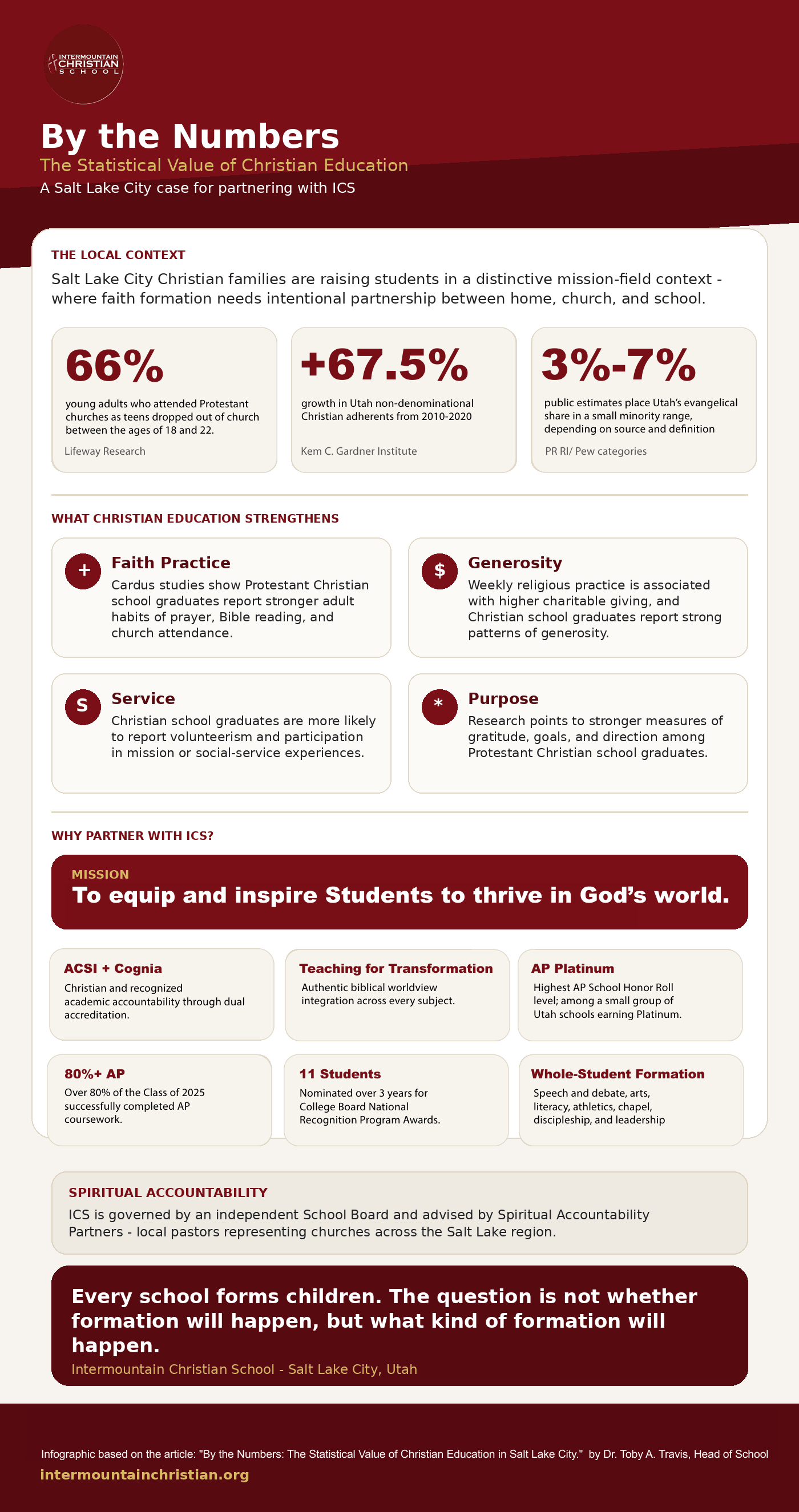
Social research has repeatedly shown that Christian school graduates, especially those who complete high school in a Protestant Christian school, demonstrate stronger adult patterns of faith practice than graduates from other school sectors. The Cardus Education Survey has found that Protestant Christian school graduates report higher levels of prayer, Bible reading, and religious-service attendance than graduates from public, Catholic, nonreligious independent, and homeschool sectors.
That does not mean every Christian school graduate remains faithful. It does not mean public school graduates cannot become deeply committed followers of Christ. Of course they can. But the research does suggest that Christian schooling is statistically associated with stronger adult faith practice.
This matters because the broader church faces a real young-adult discipleship challenge. Lifeway Research has reported that 66 percent of young adults who attended a Protestant church regularly as teenagers dropped out of church for at least one year between ages 18 and 22.
The transition from high school to young adulthood is spiritually significant. Students are not merely preparing for college or career. They are forming convictions, habits, loves, loyalties, and a sense of identity. Christian education, at its best, helps form those things intentionally.
Why the Salt Lake Context Matters
In many parts of the country, evangelical Christian families may assume that Christian faith is broadly understood by the surrounding culture. That assumption is increasingly fragile everywhere, but it is especially unwise in Salt Lake City.
Families here understand the importance of clarity. Children need to know what Christians believe, why Christians believe it, and how biblical truth speaks to every area of life. They need to learn how to love their neighbors well while also developing discernment, courage, and conviction.
This is one reason a Christian school in Salt Lake City has a distinctive role. ICS is not simply offering a private-school option. ICS is serving Christian families in a mission-field context.
For many families, partnering with ICS means their children spend their school day in a community where teachers affirm biblical truth, model Christian character, integrate faith and learning, and help students develop the tools to think Christianly about the world.
Accreditation That Matters
ICS is fully accredited by both the Association of Christian Schools International and Cognia.
That combination is significant.
ACSI accreditation reflects a commitment to Christian school excellence, biblical worldview formation, and recognized standards for Christian education. Cognia accreditation reflects a commitment to educational quality, continuous improvement, and accountability through one of the world’s largest accrediting communities.
Cognia’s lineage includes major legacy accrediting organizations such as the North Central Association Commission on Accreditation and School Improvement, the Southern Association of Colleges and Schools Council on Accreditation and School Improvement, and the Northwest Accreditation Commission. Cognia accreditation is globally recognized and connected to a large international network of schools and institutions.
For families, accreditation is more than a logo on a website. It means the school has opened itself to outside review. It means academic and organizational practices are measured against recognized standards. It means the school is committed to improvement, not merely tradition.
In Utah, this makes ICS uniquely positioned. ICS is the only ACSI-accredited school in Utah that also provides a regionally accredited K–12 program through Cognia. For families in the Salt Lake City region, that is a meaningful distinction.
Biblical Integration in Every Subject
At ICS, Christian education is not limited to Bible class or chapel. The school’s academic program emphasizes biblical integration across the curriculum so that students learn to see all truth under the lordship of Christ.
A major part of this work is implementing the Teaching for Transformation framework.
Teaching for Transformation helps teachers design learning experiences that connect academic content with biblical truth, Christian worldview, and real-life discipleship. The goal is not simply to place a Bible verse on a worksheet. The goal is to help students understand who God is, who they are, what God’s world is like, and how they are called to live within it.
This matters in every subject.
In science, students learn to study creation with wonder, humility, and intellectual seriousness.
In literature, students learn to discern truth, beauty, brokenness, redemption, and the moral imagination.
In history, students learn to examine human cultures, institutions, justice, sin, courage, and providence.
In mathematics, students learn order, logic, precision, and the consistency of God’s world.
In the arts, students learn creativity, beauty, discipline, expression, and the stewardship of God-given gifts.
In speech, debate, writing, and leadership, students learn to communicate truth with clarity, courage, and grace.
The purpose is not sheltered learning. The purpose is formed learning.
High Academics with a Higher Purpose
ICS is serious about academics. That matters.
The school’s academic program includes honors-level coursework, Advanced Placement classes, strong college and career guidance, and a commitment to helping students develop the habits of disciplined study, critical thinking, and effective communication.
Recent AP outcomes are especially noteworthy. ICS earned a place on the College Board’s AP School Honor Roll at the Platinum level, the highest level of recognition in the AP program. In Utah, only 7 percent of qualifying schools earned Platinum recognition in the 2025 AP School Honor Roll cycle.
Regularly, ICS students are nominated for the College Board National Recognition Program Award.
These are not small achievements, especially for a smaller Christian school.
Yet the purpose of academic excellence at ICS is not achievement for achievement’s sake. The school’s mission is not merely to produce high test scores or college acceptances. The mission is to equip and inspire students to thrive in God’s world.
That means academics at ICS are connected to calling. Students are challenged not only to ask, “What can I accomplish?” but also, “How can I use what God has given me to serve Him and others?”
Speech and Debate: Truth, Courage, and Communication
One example of academics connected to life skills is the strength of ICS speech and debate team.
ICS has a long tradition of helping students develop confidence, clarity, persuasion, research skills, and public communication. Recent state-championship success in speech and debate reflects more than competitive achievement. It reflects a commitment to forming students who can think carefully, speak clearly, listen respectfully, and engage ideas with courage.
These skills are urgently needed today.
Students are growing up in a world of noise, reaction, distraction, and polarization. They need to know how to reason. They need to know how to disagree without contempt. They need to know how to speak truth with grace.
Speech and debate helps students practice those habits.
For Christian students, this is not merely a performance skill. It is discipleship in communication.
The Arts: Beauty, Discipline, and Worshipful Creativity
Christian education should never reduce students to test scores. Students are whole persons, created in the image of God, with gifts that include intellect, imagination, physical movement, creativity, and expression.
ICS demonstrates this through its commitment to the arts, including visual art, music, dance, and theater.
The arts help students grow in confidence, discipline, collaboration, beauty, and courage. Theater teaches presence, empathy, memory, interpretation, and teamwork. Dance develops discipline, physical expression, artistic excellence, and stewardship of the body. Music and visual art invite students to explore beauty, creativity, and worshipful imagination.
In a Christian school, the arts are not secondary. They are part of helping students understand that God created a world filled with beauty, form, order, story, sound, and movement.
Students need opportunities to discover and develop their gifts. ICS provides those opportunities within a Christ-centered learning community.
Literacy in a Digital Age
Today’s students are growing up in a digital age marked by constant information, short attention spans, artificial intelligence, social media, entertainment saturation, and screen-based communication.
That makes literacy more important, not less.
A strong Christian education must help students read deeply, write clearly, think critically, and discern truth from error. Students need more than access to information. They need wisdom.
ICS is committed to developing a culture of literacy in a digital age. This includes cultivating reading habits, writing skills, analytical thinking, and thoughtful engagement with texts and ideas. In a world where students are often trained to skim, scroll, and react, ICS seeks to help students slow down, think carefully, read attentively, and communicate with substance.
This is both an academic and spiritual priority.
Christians are people of the Word. We should care deeply about language, truth, interpretation, attention, and understanding.
Small Class Sizes and Personalized Attention
One of the strengths of ICS is that students are known.
The school emphasizes small class sizes, personalized attention, and strong relationships between teachers, students, and families. ICS teachers invest personally in students, model Christian character, and partner with parents to help children grow.
This matters because students do not flourish in abstraction. They flourish in relationships.
A child who is known can be challenged appropriately. A child who is known can be encouraged personally. A child who is known can be corrected with care. A child who is known can be discipled with wisdom.
ICS also provides support structures such as tutoring, reading intervention, learning lab opportunities, and college and career guidance. These are practical expressions of the school’s commitment to equip students academically, personally, and spiritually.
A Graduate Profile for More Than College Admission
ICS is not aiming merely to graduate students who are accepted into college. The school’s graduate profile points to something deeper: graduates who are Christlike in character, wise, and able to influence others.
That kind of formation includes biblical worldview, faithfulness in difficulty, love in diversity, truth discernment, communication, courage, and well-rounded development.
This is especially important in Salt Lake City.
Christian students need to know how to live faithfully in a pluralistic environment. They need to build genuine friendships, serve their neighbors, communicate with humility, and remain rooted in biblical conviction. They need to be prepared not only for college classrooms and career opportunities, but also for church life, family life, civic life, and faithful witness.
Accountability Beyond the Boardroom
ICS is governed by an independent School Board, but the school is also guided and advised by Spiritual Accountability Partners. This group is made up of local pastors from the region and currently represents churches including Discovery Christian, Freedom Christian, The Well, Gospel Hope, Gospel Grace, and the Evangelical Free Church.
This is a meaningful structure.
Christian schools need academic accountability, operational accountability, and spiritual accountability. A school that claims to partner with Christian families should remain connected to the broader body of Christ. The involvement of local pastors helps reinforce the school’s Christian identity, theological faithfulness, and spiritual mission.
This does not replace the role of parents or churches. Rather, it strengthens the partnership.
Christian education is healthiest when the home, church, and school are working together.
Why Partnership Matters
The word “partnership” is important.
ICS does not replace parents. ICS does not replace the church. The school comes alongside Christian families to reinforce what parents and churches are seeking to cultivate: love for God, love for neighbor, biblical wisdom, academic diligence, moral courage, and faithful service.
For families in Salt Lake City, this partnership can be especially valuable.
When children spend their school day at ICS, they are not stepping into a spiritually neutral environment. They are stepping into classrooms where teachers are expected to integrate biblical truth. They are stepping into a community where their faith is not treated as a private add-on but as central to life and learning. They are stepping into a school that seeks to prepare them academically while also forming them spiritually and personally.
That kind of partnership is not incidental. It is vital.
The Statistical Value and the Local Opportunity
The national research on Christian education is encouraging. Protestant Christian school graduates demonstrate stronger patterns of adult faith practice. They are more likely to report habits such as prayer, Bible reading, religious-service attendance, generosity, and service. These outcomes are not automatic, but they are meaningful.
In Salt Lake City, those outcomes take on local urgency.
Christian families here are raising children in a distinctive mission-field context. The need for faithful formation is not theoretical. It is daily. It is relational. It is cultural. It is spiritual.
ICS offers a unique combination of Christian discipleship, academic excellence, biblical worldview integration, recognized accreditation, AP achievement, arts, athletics, literacy, communication, leadership, and personal attention.
The school is not perfect. No school is. But ICS is intentionally pursuing a vision that matters deeply: to equip and inspire students to thrive in God’s world.
Conclusion: An Invitation to Consider What Formation Is Worth
Every school forms children.
The question is not whether formation will happen. The question is what kind of formation will happen.
Will students be formed to see truth as personal preference or as grounded in God’s reality?
Will they be formed to see achievement as self-promotion or as stewardship?
Will they be formed to see knowledge as power or as a gift to be used in service?
Will they be formed to see faith as a Sunday activity or as the center of all life?
For Christian families in Salt Lake City, these questions are too important to ignore.
The statistical value of Christian education is significant. But the deeper value is spiritual, personal, and eternal. Christian education helps students connect learning with faith, excellence with humility, achievement with service, and identity with Christ.
That is why ICS matters.
That is why Christian families should give serious consideration to partnering with Intermountain Christian School.
And that is why, in this unique region and at this important moment, Christian education is not merely an option.
It is a vital investment in the next generation.
© 2026 Toby A. Travis. All rights reserved.
